Why stablecoins are building a new global banking system

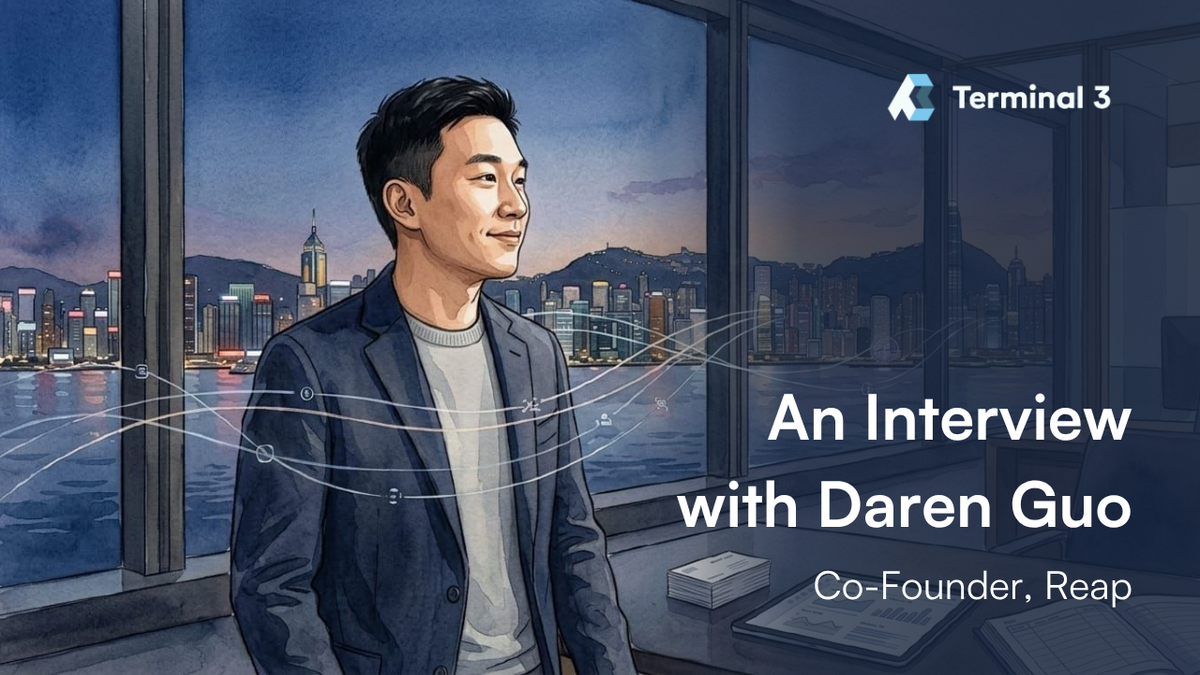
Our newest blog post is a little different, an interview with Daren Guo, co-founder of Reap. Reap is a Hong Kong-based stablecoin infrastructure platform that lets businesses issue cards, manage business accounts and expenses, and make global payments using stablecoins.
Reap was acquired by Payward, the parent company of US-headquartered crypto exchange Kraken, for $600 million. The deal is one of the largest acquisitions of a Hong Kong tech startup ever.
Daren shared his views on the adoption of stablecoins, web3 regulation, AI and other industry topics. The conversation has been edited for clarity and readability.
Terminal 3: You were an early employee in Stripe, which has been one of the most successful fintech startups in history. How did you go from that enviable position to starting your own business that’s based around stablecoins and blockchain?
Daren Guo: Our journey has been very non-linear. I come from a traditional payments background. Before I started Reap, I worked at Stripe. I was there for five years, both in San Francisco and then in Singapore.
When we started Reap, it was very much not about stablecoins or cards. I started out as a crypto sceptic. So it's been an iterative, incremental build to get to where we are today.
When we first started thinking about stablecoins, it was really about trying to figure out a way to provide more financial access to people who needed it most. Existing financial infrastructure didn't enable us to extend products and services into some emerging markets we were thinking of.
And then you combine that with the fact that money movement in developed markets is actually quite well built. You can move money from Hong Kong to somewhere else pretty easily, but if you apply the lens of emerging markets, that's just fundamentally untrue.
If the fiat system had allowed us to do that, and had just added digitisation or APIs there, we wouldn't even need to think about stablecoins. It really came from the bottom-up problem we were trying to solve, as opposed to us looking at stablecoins as some big trend.
You also have to realise that when stablecoins first started, they were just an on-ramp to crypto, to trading and speculation. They were not really used for money movement. But for us, we always focused on that because of my background and because of where we saw financial access was lacking.
Fast forward to now, and there are a lot more entrants into the space. But that is also combined with a lot more mainstream acceptance and excitement.
So I think the arrival of some of these larger players has actually been a net positive in a lot of ways. If we were the only ones doing this, we'd run into issues. It wouldn't make sense for one single player to try to expand the whole category alone.
With stablecoins, we're still extremely early. If you look at stablecoins as a market, it's about $200 billion. If you look at anything related to global cross-border trade, it's in the tens of trillions.
T3: What do customers gain from using your services?
DG: Efficiency is a major appeal of what we do. If you think about the rise of AI agents, the infrastructure needs to become more programmable, real-time and available 24/7 for those agents to do their work.
So you can think about all the optimisations around treasury and FX that need to happen without a human in the loop. Those two concepts together make a lot of sense from an internal operations perspective.
The other thing that's exciting, and not talked about nearly as much, is that stablecoins are a catalyst for broader financial change.
Before stablecoins, serving emerging markets well wasn't really something people were pushed to think about. Otherwise they would already have built much better correspondent banking infrastructure into those markets. But they didn't.
Now that stablecoins exist, institutions at least have a reason to start thinking about those markets more seriously.
So the idea of financial services evolves into something that has to serve global demand. Previously you had domestic payment systems, domestic cores, real-time payment systems in the UK, the US and so on.
Stablecoins are effectively saying: don't think about this from a purely domestic standpoint, think about it from where the actual demand is. That pushes everything, including regulation and compliance, in a more international direction by default.
That's very exciting. It's an opportunity for banks to rethink their go-to-market, their revenue mix, and how they serve some of these customers, using stablecoins as a catalyst.
The last point I'd make is that financial services hasn't changed all that much. Payments are still point A to point B. Cards are still cards. Trade finance is still trade finance. These concepts haven't evolved that much.
What internet-native infrastructure can do is create new payment modalities that fundamentally can't exist today. Things like streaming payments, where I'm paying you every millisecond that you're working. Those kinds of things need infrastructure that is more internet-native.
T3: What's the difference you see between regulators, banks and the broader establishment in markets like Hong Kong and Singapore versus the US, the UK and Europe?
DG: Two things jump out immediately. First, it starts with the problem you're trying to solve. US financial infrastructure is very much built for US businesses. If you want to get a bank account there, you basically have to have a US-domiciled business.
That's not true in Singapore and Hong Kong. A Thai business, a US business, can be set up there to facilitate trade, and the infrastructure is better suited to solving international use cases.
That's the role of Singapore and Hong Kong. They're not only built for Hong Kong or Singapore businesses, they're built for international trade and international business.
If you look at Hong Kong specifically, bank accounts are multi-currency by default. My bank account has the ability to hold 14 different currencies. In the US, even if you want to hold Canadian dollars, you often need some sort of brokerage account or additional setup.
That multi-currency setup is just one example of infrastructure designed for global financial use cases. So that's why I think Asia, from both a regulatory and infrastructure perspective, is better positioned for some of these stablecoin use cases.
T3: Hong Kong has issued its first stablecoin licences. What does that do for you, for the business and the industry?
DG: More than anything, it establishes a foothold for the concept of stablecoins in the financial industry. It says Hong Kong is open to these kinds of assets.
So from that perspective, it helps drive acceptance and willingness to at least think about proof-of-concepts related to them.
To drive usage, you need utility, and payments is often the first obvious use case, or one of a few obvious use cases.
T3: We have regulation, we have infrastructure companies like Reap but what does adoption look like in the coming three to five years? What's going to enable every bank in the world to use stablecoins?
DG: If you look at banks, they're not supposed to move at the speed of tech. The consequences of failure are much higher. So what I think is going to happen is that banks will adopt this iteratively through specific use cases, as opposed to companies like us, which are embracing it from a more tech-native perspective.
For example, we've been speaking with certain banks in Latin America about using stablecoin infrastructure for cross-border flows. The key is finding ways to enable them to solve their existing problems, especially cross-border challenges, in a way that is more off the shelf.
That's going to be critical. As this technology goes mainstream, the highly customised and iterative setups that might work with some early partners won't work for larger institutions. They will want off-the-shelf solutions around custody, compliance and other core pieces.
That's critical, because if banks try to build everything themselves, it will be too slow, and I don't think they have the expertise to do it all internally.
So it's really about packaging something in a way that is appropriate for them.
T3: How are you using AI, and more broadly how do you see the industry using it?
DG: If anyone really knows the answer to the second part of that question, they'll be in a very strong position.
Internally, we're pushing AI adoption in a pretty serious way.
Maybe I’ll use design, product management and engineering as an example. For example, a designer can design something and have it go directly into code. A product manager can create a document, push it into an AI tool, and it can generate pull requests automatically.
So those three previously distinct functions can start to merge in a lot of ways.
So it's forcing us to rethink how companies should be structured, how things should be built, and what systems and processes need to change.
No one really has all the answers yet, but those are the things we're thinking about.
T3: I think there are also trust issues. There’s been a lot of talk about AI for a long time, and maybe the performance is only now getting to where people expected it to be earlier. People get burnt by the hype.
DG: So if you tell someone, "I've got a chatbot that can do customer service for you," they don't really believe you because they've used chatbots before and they were basically just workflows.
So there is a trust and education gap, and especially when it comes to money and payments, people are going to take a lot less risk than they would elsewhere. But the potential is there.
T3: Do you use AI for AML? Have you managed to tighten that process?
DG: It's a constantly iterative process, because as your systems get more AI-enabled, the fraudsters get more AI-enabled too. We're currently thinking about the entire customer journey, including what happens after onboarding and as customers scale.