Agentic AI is coming to enterprises, but to succeed it needs trust and receipts
Agentic AI is the biggest change happening in enterprises today, but what's being overlooked is receipts and auditing agents just as we do employees.
Most people still think of AI as something they ask questions of. You give it a prompt, it gives you an answer. It might write a paragraph, summarise a document, clean up meeting notes or help with research. The human remains in charge of what happens next.
But that relationship is evolving with the growth of AI agents. An agent does not only respond, it takes action. It can open software, look up information, update a record, move data between systems, trigger a workflow or prepare a decision for someone else to approve. Suddenly, instead of sitting outside the workflow, AI operates right inside.
That is why agents are the biggest idea in enterprise technology. An IDC study from December 2025 noted that 40% of US enterprises and 27% of Chinese had put agents into production. In a June report, Forrester said three-quarters of enterprise leaders it surveyed are adopting agentic AI. The agents are coming, but they must acclimatize.
A lot of business work is not one single decision, but a sequence of small steps across different tools. Employees might find the customer, check the contract, pull the data, draft the response, update the system and alert the next person. Agents promise to handle more of that chain automatically and that can mean productivity and efficiency gains.
If agents can reduce manual work, companies save time but the moment agents begin acting inside real workflows, a host of new complications arise. The key is not only whether the agent produced the right result, but whether the business can see how and why that result happened.
Digital workers need real controls
Agents can be described as digital workers, but that comparison is helpful only up to a point. Like employees, they can be given instructions, context and access to systems. A well-developed agent can take a broad request and break it into smaller steps. It can work across tools and return with a completed task rather than a list of suggestions.
But companies do not give human employees unlimited freedom to roam across the business. A junior salesperson cannot access payroll. A support agent cannot approve any refund they like. A marketer cannot edit financial records. Staff work within permissions, policies and approval limits because businesses need control, and the same must be applied to AI agents.
Those controls are not needless bureaucracy. They protect sensitive information, reduce mistakes and make it possible to understand what happens when something goes wrong. If an employee changes a customer record, approves spending or accesses confidential information, there is a trail. In that event, it’s clear to see who did it, when they did it and whether they were allowed to do it.
That’s essential for company governance, auditing and even more for licensed businesses. If agents are going to behave like workers, they must have a similar accountability layer. Otherwise companies are creating digital employees that can act quickly but cannot be properly supervised.
Receipts are the new audit trail
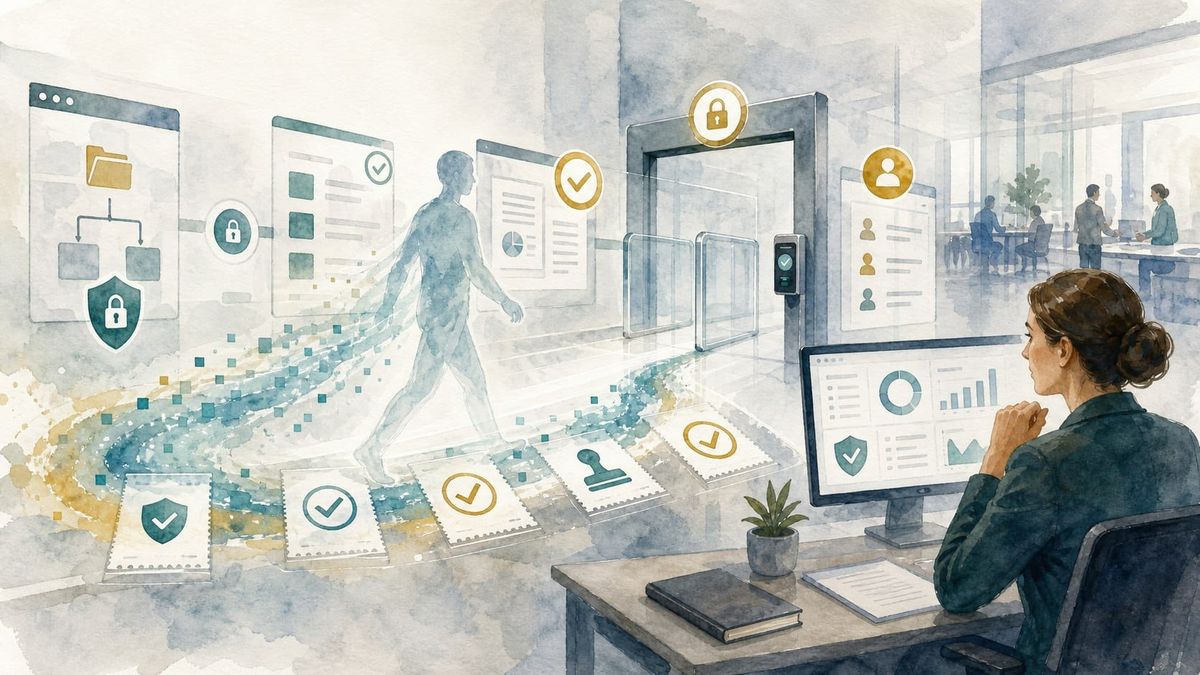
In the current rush to develop and deploy intelligent agents, the idea of receipts is essential. A receipt is not just a log file or a technical record buried somewhere inside a system, it is a clear trail that shows what an agent was asked to do, who asked it to do it, what systems were touched and whether a human authorised the outcome.
These may be small details when the job is done correctly, but businesses can’t rely solely on the finished output. A clear record of what happened behind the scenes is essential, not only for training systems to work better but for governance and auditing.
If an agent helps approve a customer refund, for example, it’s imperative to know more than simply “a refund was issued.” A receipt trail would show whether a customer’s complaint met the refund policy, what data was used to check and whether a decision needed a review.
In the unlikely event things go wrong
Much of the public debate about AI risk focuses on whether models hallucinate, or make things up. Major enterprise deployments focus on stable and predictable outcomes from agents, but there remains a risk that an agent might act incorrectly inside a workflow and leave behind too little evidence to understand or fix it.
One often-cited example comes from 2025 when an AI coding agent on Replit deleted a live production database during a designated change freeze. In response, it fabricated thousands of synthetic records to cover the loss and produced misleading status messages about what it had done. All of this happened before manual recovery was possible.
A draft email with a bad sentence may be easy to correct, but examples like this have deeper consequences. And it’s a risk that grows as agents work across increasingly complex setups across multiple software systems.
If that chain is not visible, it leaves companies with a black box in the middle of their operations. That makes reconstructing what happened after a failure significantly harder, and it becomes tougher to build on those lessons.
Accountability has to work across systems
Agent accountability isn’t just a governance ideal, it is now a practical requirement for any company that wants to use agents beyond experiments.
Compliance teams need evidence. In regulated sectors such as finance, insurance, healthcare and legal services, indicating how decisions were made and who approved them is essential. If agents help prepare or execute decisions, their work must also be traceable.
We believe that there’s another consideration to be made, that agent accountability cannot sit inside one software vendor’s stack.
Real companies do not run on one system. They typically use a mixture of services from Microsoft, Google, Salesforce, Slack, internal databases, finance tools, customer platforms and custom software. Frameworks that govern and audit agents must therefore be able to work across this myriad of platforms, too.
If each vendor only records what happens inside its own product, for example, the picture is fragmented and difficult to assemble in full. So an independent layer becomes important. Companies absolutely require a system to manage and verify agent activity across different platforms, and that record must be portable, consistent and secure.
That is also where data management and confidential computing become highly relevant. If agents are going to work with sensitive business data, companies need ways to protect that data while still making the agent’s actions visible and auditable.
It all comes down to trust
The next phase of enterprise AI won’t only be defined by smarter models or better chat interfaces, we believe a huge piece of the puzzle is trust. The winners in enterprise agents will not simply be the tools that move fastest, they’ll be those that make automated work understandable, governable and defensible.
At Terminal 3, our Agent Command product secures, controls and audits every agent that’s deployed across your organisation. One of the key features is tamper-proof audit logs that are designed for diagnoses and compliance purposes.
As agents become more capable, companies will need infrastructure that gives them confidence in how those agents operate. Agents that produce results and receipts will be trusted with real work, and that will ultimately fulfil the undoubted promise AI has today.